Short answer: If your dog pulls on leash, start practicing somewhere quiet and reward the moments when the leash is loose, so walking near you pays off. When the leash tightens, pause, wait for slack, and move on again, then add busier places only as your dog copes. Skip leash jerks and corrections; if pulling comes with fear, lunging, pain or unsafe handling, get individual help first.
Why does my dog pull on the leash?
Pulling usually works for the dog. Leaning into the leash has gotten them to the smell, the person or the park before, so they keep doing it. Dogs also walk faster than we do, and a busy street is full of things worth reaching.
Notice what your dog is heading toward, or away from. Pulling to sniff, pulling to greet and pulling away from something scary need different plans. If your dog is also barking or lunging, read why dogs bark and lunge on leash before treating it as a walking-manners issue.
What does loose-leash walking actually mean?
Here, loose-leash walking means moving together without steady tension on the leash. It does not mean a strict heel for the whole walk. Your dog can still sniff, explore and stop, as long as the leash stays slack most of the time.
How do I teach my dog to stop pulling, step by step?
- Check safety and gear. Use comfortable, well-fitting equipment. A harness can be easier on the neck for a dog who pulls; see harness or collar.
- Start somewhere boring. A hallway, yard or quiet street at a quiet hour. Practice where your dog can succeed, not on the hardest stretch of the route.
- Reward slack. Each time the leash is loose and your dog is near you, mark it ("yes") and drop a small, tasty treat by your leg.
- Pause when it tightens. Stop walking calmly. The moment the leash slackens, praise and move forward again. No jerking, no scolding.
- Change direction when needed. If your dog is stuck on something, turn and walk the other way cheerfully, and reward when they catch up on a loose leash.
- Build up slowly. Add distance, movement and distractions a little at a time. If pulling returns, go back to an easier place for a while.
- Give sniff breaks. Let your dog sniff on purpose ("go sniff") as a reward. A planned sniff walk takes some of the urgency out of pulling.
What should I do when the leash goes tight?
During normal practice, stop and wait for slack, then continue. If the same spot keeps causing pulling, change the setup: walk there at a quieter time, add distance, or skip it for now. Repeating the hardest part over and over mostly practices pulling.
Safety comes first. If something frightening is approaching, don't stand still to make a point. Move away calmly; training can happen another day.
What mistakes make leash pulling worse?
Common ones: practicing only on busy streets, rewarding pulling by following the dog wherever they pull, expecting a tool to teach the skill, and using leash pops or pain-based equipment. Corrections can add stress and do not teach your dog what to do instead.
When should I get individual help?
Get support from your vet and a qualified reward-based trainer if pulling comes with pain, fear, lunging, or if you can't hold the leash safely. A sudden change in walking behavior deserves a vet check.
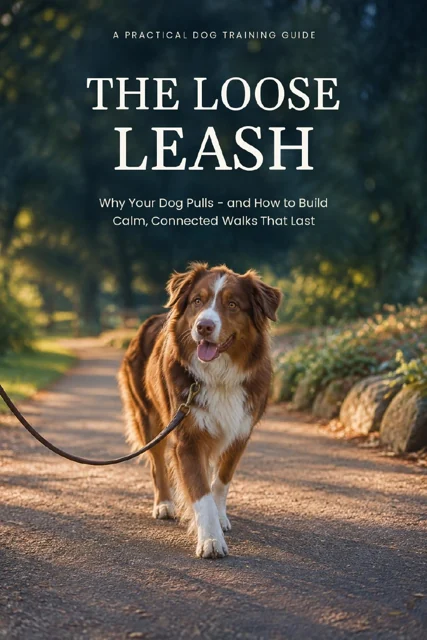
If you'd like a fuller walk-by-walk plan, The Loose Leash guide walks through loose-leash training in more detail. The first chapter is free to read on the site.
Sources
- Dogs Trust, walking nicely on a lead
- Dogs Trust, pulling on lead
- Dogs Trust, reward-based training
- AVSAB, position statements
Frequently asked questions
Does loose-leash walking mean my dog can never sniff?
No. The goal is a walk without steady leash tension, not a strict heel. You can build in planned sniff breaks as a reward.
Why does my dog walk nicely at home but pull outside?
Outside has far more distractions, and distractions make the skill harder. Start somewhere quiet and add difficulty gradually.
Will a different harness or collar stop my dog pulling?
Comfortable gear can help, but no piece of equipment teaches the skill on its own. Reward-based practice does the teaching.
Should I jerk the leash when my dog pulls?
No. Leash corrections can add stress and pain without showing your dog what to do. Pause, wait for slack and reward it instead.
How long does it take to stop leash pulling?
There is no fixed timeline. Short, regular practice in easy places usually helps more than long, frustrating walks.
When to get individual help
Seek support for unsafe handling or repeated distress. Veterinary and qualified behaviour help can guide the plan; do not provoke a reaction to gather information. [3,4]
If you want to explore resources for several parts of a walk, see the five-guide walking collection. Choose it for its relevant topics, not as a promise that a guide replaces individual help.
General education only. This article does not diagnose your dog or provide an individual veterinary or behaviour-treatment plan.
Sources
Sources checked on 12 November 2026. No expert-review or trainer-authorship claim is made.
[1] Dogs Trust, walking nicely on a lead: https://www.dogstrust.org.uk/dog-advice/training/outdoors/walking-nicely-training
[2] AVSAB, position statements and humane dog-training guidance: https://avsab.org/resources/position-statements/
[3] Dogs Trust, reactive dogs: https://www.dogstrust.org.uk/dog-advice/training/unwanted-behaviours/reactive-dog
[4] VCA Animal Hospitals, desensitization and counterconditioning: https://vcahospitals.com/know-your-pet/overcoming-fears-with-desensitization-and-counterconditioning
[5] Dogs Trust, reward-based training: https://www.dogstrust.org.uk/dog-advice/training/techniques/positive-reinforcement-training-with-rewards
What happens with the leash?
Choose what fits. Nothing is saved or submitted.
Source: Dogs Trust, “Dog walking problems, pulling on leash and how to help,” https://www.dogstrust.org.uk/dog-advice/training/unwanted-behaviours/pulling-on-lead .
Sources & care notes
This article is general education, not veterinary advice. If your dog seems unwell, is in pain, or something changed suddenly, call your vet. If it could be an emergency, do not wait.